Top Asbestos Surveys London: A Fast, Reliable, and Affordable Guide
I. Introduction: The Hidden Danger in London’s Properties and Your Path to Peace of Mind
For any property owner, landlord, or developer in London, the word “asbestos” can evoke a sense of uncertainty and concern. Lurking unseen within the walls, ceilings, and floors of countless buildings constructed before the year 2000, this hazardous material represents a significant, yet often overlooked, risk. The question for those responsible for these properties is not
if they should think about asbestos, but when they need to act to ensure the safety of occupants and comply with stringent UK laws.
The challenge is particularly acute in London, a city defined by its rich and diverse architectural heritage. The building stock presents a unique tapestry of asbestos risks, from the charming Victorian and Edwardian terraces of inner London boroughs like Lambeth and Westminster, which often contain asbestos from mid-20th-century refurbishments, to the sprawling post-war housing estates found across South London in areas such as Croydon, Bromley, and Southwark. Each property type, from a commercial tower in Canary Wharf to a residential flat in a suburban block, carries its own legacy of construction materials and, therefore, its own specific asbestos profile.
Navigating this complex landscape requires more than just a service; it requires a trusted partner. At Surrey Asbestos Surveys, we are not just surveyors. We are expert consultants dedicated to providing clarity, safety, and comprehensive solutions. We specialise in serving our communities across London, with a particular focus on the unique property challenges of South London, offering a complete pathway from initial asbestos survey and testing to safe removal and disposal. Surrey Asbestos Surveys offers a comprehensive range of asbestos services delivered by qualified asbestos surveyors with extensive experience in the industry. We serve commercial properties, residential properties, and industrial property across London and the South East, ensuring compliance and safety for all types of buildings.
This guide is designed to be your definitive resource. It will walk you through the entire process, empowering you with the knowledge to make informed decisions. We will explore the very real risks of asbestos and the strict legal duties you hold. We will demystify the different types of asbestos surveys, explain what to expect from a professional inspection, and show you how to interpret the results. Crucially, we will detail how to identify a truly competent, accredited surveyor and outline the safe, regulated steps that must be taken once asbestos is found. Our goal is to transform your uncertainty into confidence, providing a clear roadmap to a safe, compliant, and asbestos-aware property.
II. Why Asbestos is a Critical Concern: Understanding the Risks and Your Legal Duties
Before delving into the solutions, it is vital to understand the gravity of the problem. Asbestos is not a minor building issue; it is a serious health hazard governed by strict legislation. Exposure to asbestos can cause a range of health issues and serious health problems, making proper management essential. Acknowledging this reality is the first step toward responsible property management.
A. The Human Cost: The Unseen Killer
The stark truth is that asbestos is the single biggest cause of work-related deaths in the United Kingdom. According to the Health and Safety Executive (HSE), asbestos-related diseases claim over 5,000 lives every year—a staggering figure that underscores this is not a historical footnote but an ongoing public health crisis. The danger lies in the microscopic, needle-like fibres that are released when asbestos-containing materials (ACMs) are disturbed or damaged. Once inhaled, these fibres can become lodged deep within the lungs, leading to several devastating and often fatal diseases, typically decades after the initial exposure.
- Mesothelioma: This is a rare and particularly aggressive form of cancer that affects the lining of the lungs and abdomen. It is almost exclusively caused by asbestos exposure and has an extremely long latency period, often taking 20 to 50 years for symptoms to appear. The prognosis is tragically poor, with a median survival rate of just 12 to 21 months after diagnosis. The latest HSE statistics show that mesothelioma was responsible for 2,257 deaths in 2022 alone.
- Asbestos-Related Lung Cancer: The number of deaths from lung cancer caused by asbestos exposure is estimated to be on par with mesothelioma, claiming another 2,500 lives annually in the UK. The risk of developing lung cancer is significantly amplified for individuals who smoke and are also exposed to asbestos.
- Asbestosis: This is a chronic and irreversible respiratory disease where the lung tissue becomes heavily scarred due to prolonged, heavy exposure to asbestos fibres. This scarring, or fibrosis, severely impairs lung function, leading to extreme shortness of breath, disability, and ultimately, death.
The long latency period of these diseases is precisely why continued vigilance is paramount. The thousands of people who tragically die each year were often exposed in the 1960s, 70s, and 80s. Protecting the health of today’s generation means proactively managing the vast quantities of asbestos that remain in our buildings.
B. Your Legal Obligations: The Control of Asbestos Regulations 2012 (CAR 2012)
Beyond the profound health implications, there is a robust legal framework in place to protect people from asbestos exposure. The cornerstone of this is the Control of Asbestos Regulations 2012 (CAR 2012). These regulations are not suggestions; they are the law, and failure to comply can have severe consequences.
Central to CAR 2012 is Regulation 4, the “Duty to Manage” asbestos. This legal duty applies to the person or organisation that has maintenance and repair responsibilities for non-domestic premises. This includes a vast range of properties such as offices, retail stores, industrial units, schools, and hospitals. Importantly, it also applies to the common areas of residential apartment blocks and flats, such as foyers, corridors, and lift shafts.
The duty holder is legally required to:
- Find Asbestos: Take all reasonable steps to determine if asbestos-containing materials are present or are likely to be present.
- Presume Presence: Unless there is strong evidence to the contrary, it must be presumed that materials contain asbestos.
- Create a Record: Prepare and maintain an up-to-date Asbestos Register that details the location, type, and condition of any identified or presumed ACMs.
- Assess the Risk: Carry out a formal assessment of the risk posed by the asbestos.
- Create an Asbestos Management Plan: Prepare a detailed asbestos management plan outlining how the risks will be managed over time. It is essential that asbestos management plans are managed correctly to ensure compliance with regulations and to protect health and safety.
- Inform Others: Provide information on the location and condition of the ACMs to anyone who is liable to work on or disturb them, such as builders, plumbers, electricians, and other contractors.
The penalties for failing to comply with the Duty to Manage are significant and designed to be a powerful deterrent. A duty holder found to not have an adequate asbestos management plan in place can face fines of up to £20,000 or imprisonment. For more serious breaches of the regulations, the fines are unlimited and can be accompanied by a prison sentence of up to two years. This legal reality makes professional asbestos surveys and management an absolute necessity for commercial property owners and managers.
C. The Homeowner’s Responsibility: A Crucial Distinction
While the formal “Duty to Manage” under Regulation 4 does not apply to private homeowners in their own domestic properties, this does not mean they are free from all responsibility. This is a critical point of confusion for many. The moment a homeowner decides to carry out any intrusive work—be it a major renovation, a loft conversion, or even simple tasks like drilling into walls or removing textured coatings—they and the contractors they hire fall under the umbrella of other health and safety legislation, including the Health and Safety at Work etc. Act 1974 and other provisions within CAR 2012.
A contractor has a legal duty to protect their employees and others from exposure to asbestos. Therefore, any reputable builder or tradesperson will, and should, refuse to start work on a pre-2000 property without seeing an asbestos survey first. An asbestos inspection is often required as part of property due diligence, especially for buyers, sellers, and leaseholders, and is frequently requested by solicitors to ensure compliance with health and safety regulations. An unscrupulous contractor who proceeds without a survey is not only breaking the law but is also recklessly endangering their own health, the health of their team, and the health of the homeowner and their family. This would also leave the homeowner exposed to potential legal action.
For this reason, commissioning an asbestos survey is not just a recommendation for homeowners; it is a practical and moral necessity before undertaking any renovation or refurbishment project. It is about smart planning, protecting your family’s health, and preventing your project from being derailed by the unexpected and costly discovery of asbestos mid-way through. This proactive approach transforms the survey from a perceived cost into a vital investment in safety and project security.
III. The Solution: A Comprehensive Guide to Professional Asbestos Surveys
Once you understand the risks and your responsibilities, the path forward becomes clear. The first, indispensable step in managing asbestos is to commission a professional asbestos survey. All our surveys are conducted in accordance with the latest legal and industry standards, ensuring comprehensive detection, reporting, and client consultation. Asbestos testing is an integral part of the process, providing definitive analysis of suspected materials. This is the foundation upon which all safe and compliant decisions are built.
A. What is an Asbestos Survey? The First Step to Safety
An asbestos survey is a formal, systematic inspection of a property to locate, quantify, and assess the condition of any asbestos-containing materials (ACMs). It is a technical process carried out by a competent surveyor who uses their expert knowledge of building construction, materials, and asbestos legislation to identify potential hazards. Qualified asbestos surveyors bring specialized knowledge and professionalism to every inspection, ensuring that all assessments are thorough and compliant with regulations.
The surveyor’s role is multifaceted. They conduct a thorough inspection, identify materials that are suspected to contain asbestos, and where necessary, take small, controlled samples for definitive analysis. The ultimate goal is to provide the client with a clear, comprehensive, and actionable report that forms the basis of their asbestos management strategy.
B. Choosing the Right Survey for Your London Property
The Health and Safety Executive (HSE) clearly defines two principal types of asbestos surveys, each designed for a specific purpose. Asbestos management surveys are considered the standard survey type, providing a non-intrusive assessment aimed at identifying asbestos-containing materials for ongoing safety and compliance in buildings. Choosing the correct one is crucial for ensuring both compliance and safety. At Surrey Asbestos Surveys, we guide our clients to ensure they select the most appropriate and cost-effective option for their needs.
Management Survey (Formerly Type 1 & 2)
- Purpose: The goal of a Management Survey is to manage ACMs during the normal, everyday occupation and use of a building. It is designed to identify asbestos that could be damaged or disturbed by normal activities or foreseeable maintenance, allowing the duty holder to create an effective management plan.
- Methodology: This survey is primarily visual, but it is not passive. The surveyor will inspect all accessible areas, including lifting ceiling tiles, opening access hatches, and checking service risers. Minor intrusive work is involved to take small, discreet samples of suspect materials to either confirm or rule out the presence of asbestos. The aim is to be as thorough as possible without causing significant damage to the building’s fabric.
- Outcome: The key deliverables of a Management Survey are a comprehensive Asbestos Register and the information needed to formulate a long-term Asbestos Management Plan.
Refurbishment/Demolition Survey (Formerly Type 3)
- Purpose: This survey is a legal requirement before any refurbishment, renovation, or demolition work is carried out on a pre-2000 building. Its objective is to locate and identify all ACMs in the specific areas where the work will take place, or throughout the entire building in the case of demolition. This includes materials hidden deep within the building’s structure.
- Methodology: A Refurbishment/Demolition (R&D) Survey is, by necessity, fully intrusive and destructive. Surveyors will need to break through walls, lift floorboards, access structural columns, and inspect all voids to find hidden materials. Because of the potential to disturb asbestos, the surveyed area must be vacant during the inspection and certified as ‘fit for reoccupation’ by the surveyor before anyone can return.
- Outcome: The R&D survey produces a detailed report that acts as a map, pinpointing all ACMs that must be safely removed by a specialist contractor before the main construction or demolition project can begin.
To provide absolute clarity, the table below summarises the key differences, helping you understand which survey is right for your situation.
| Survey Type | Primary Purpose | When It’s Required | Methodology | Key Outcome |
| Management Survey | To manage asbestos during normal building occupation and for minor maintenance. | For all non-domestic properties built before 2000 (as part of ‘Duty to Manage’). Recommended for homeowners for awareness. | Largely visual inspection of accessible areas. Minor intrusion (e.g., lifting ceiling tiles). Sampling of suspect materials. | A comprehensive Asbestos Register and a long-term Asbestos Management Plan. |
| Refurbishment/Demolition Survey | To locate and identify all asbestos materials before any structural work begins. | Legally required before any refurbishment, renovation, or demolition project in a pre-2000 building. | Fully intrusive and destructive. Requires breaking into the building fabric. The area must be vacant. | A detailed report mapping all ACMs for safe removal before the main project starts. |
C. The Surrey Asbestos Surveys Process: Your Journey with Us
We understand that dealing with asbestos can be daunting. That’s why we’ve developed a clear, client-focused process designed to be as straightforward and stress-free as possible. Surrey Asbestos Surveys work closely with clients and removal specialists to ensure safety, compliance, and effective project execution.
- Step 1: Initial Consultation & Quoting: Your journey begins with a simple phone call or email to our friendly team. We provide a no-obligation consultation where we take the time to listen to your specific needs. We’ll ask about your property—its age, type, and location (for instance, a 1970s terraced house in South London)—and any planned works. Based on this, we provide expert advice on the correct survey type and a clear, transparent quote with no hidden fees.
- Step 2: The On-Site Survey: Our professional surveyor will arrive at your property at the scheduled time. They will begin with a brief walk-through to confirm the scope of work and conduct a final risk assessment. Then, they will carry out the survey methodically and efficiently, treating your property with respect. For Management Surveys, they will take small, targeted samples with minimal disruption. For R&D surveys, they will conduct the necessary intrusive work in the agreed (and vacated) areas.
- Step 3: Independent Laboratory Analysis: To ensure complete impartiality and accuracy, all samples are sent to a separate, independent laboratory for analysis. These labs are accredited by UKAS to the ISO/IEC 17025 standard, the international benchmark for testing competence. This crucial step guarantees that the results are reliable and unbiased, forming a solid foundation for your report.
IV. Decoding Your Asbestos Survey Report: From Data to Decisions
Receiving your asbestos survey report is a pivotal moment. It is the document that translates the on-site inspection and lab analysis into a clear, actionable plan. A report from a competent firm like Surrey Asbestos Surveys will not be a confusing data dump; it will be a tool that empowers you to manage risk effectively. Importantly, the report plays a crucial role in ensuring safety for all occupants and contractors by supporting compliance with regulations and safety protocols.
A. The Anatomy of a Professional Report
According to HSE guidance, a final survey report must be clear, unambiguous, and readily accessible to those who need it. When you receive your report from us, you should expect to see these essential components, which provide a complete picture of the asbestos situation in your property:
- Executive Summary: This is a concise, top-level overview. It immediately tells you the main findings of the survey and lists the most important recommendations, allowing you to grasp the key takeaways quickly.
- Introduction and Scope of Work: This section clearly defines the purpose of the survey, the date it was conducted, and precisely which areas of the property were included in the inspection. It will also note any areas that were inaccessible and have therefore been presumed to contain asbestos.
- Survey Results and Material Assessment: This is the detailed heart of the report. For every ACM identified, it will specify its exact location (often supported by photographs and marked-up floor plans), the product type (e.g., asbestos insulating board, textured coating), and the type of asbestos fibre confirmed by the lab (e.g., Chrysotile, Amosite). It also includes a “material assessment” score, which evaluates the material’s type and condition to determine its potential to release fibres if disturbed.
- Priority Assessment and Overall Risk Score: The report goes beyond just the material itself. A “priority assessment” is made, which considers the likelihood of the ACM being disturbed based on factors like its location, the extent of use of the area, and planned maintenance activities. The material and priority scores are often combined to produce an overall risk score, which is invaluable for prioritising any necessary remedial actions.
- Clear Recommendations and Further Actions: For each and every ACM, the report will provide a clear, direct recommendation. This could be to “Manage in-situ,” “Encapsulate,” or “Remove.” This guidance is what allows you to move from assessment to action.
- Bulk Analysis Certificate: This is the official, certified report from the UKAS-accredited laboratory, providing the definitive results of the sample analysis. It is your independent proof of the findings.
B. The Asbestos Register: Your Live Management Tool
The information from the survey report is used to create one of the most important documents required by law: the Asbestos Register. It is critical to understand that this is not a one-off document that gets filed away. The Asbestos Register is a “live” document that must be kept on-site (in either paper or electronic format) and must be regularly updated.
Its primary purpose is to serve as the definitive record of asbestos in your building. It must be made available to any contractor, maintenance worker, or emergency service personnel before they begin any work on the premises. This simple act of communication is one of the most effective ways to prevent accidental exposure. The register must be reviewed at least once a year, or more frequently if the condition of an ACM changes or if work is carried out that could affect it.
V. The Hallmark of Excellence: Why UKAS Accreditation is Your Non-Negotiable Guarantee
In an industry where the stakes are so high, how can you be certain you are choosing a truly competent surveyor? The answer lies in one acronym: UKAS.
A. Understanding UKAS: The Government’s Gold Standard
The United Kingdom Accreditation Service (UKAS) is the sole national accreditation body recognised by the UK government. Its role is to assess organisations that provide inspection, testing, and certification services against internationally agreed-upon standards. This process is independent, rigorous, and provides an authoritative declaration of an organisation’s competence and integrity.
For the asbestos industry, there are two critical standards:
- ISO/IEC 17020: The international standard for the competence of bodies performing inspection. This is the accreditation that asbestos surveying companies should hold.
- ISO/IEC 17025: The international standard for the competence of testing and calibration laboratories. This is the accreditation that labs analysing asbestos samples must hold.
B. The Accreditation Paradox: Why “Strongly Recommended” Means “Essential”
Herein lies a crucial nuance of the regulations. While the law mandates that sample analysis must be done by a UKAS-accredited laboratory, it does not strictly mandate that the surveyor themselves must be accredited. Instead, the HSE strongly recommends using surveyors accredited to ISO/IEC 17020.
This “strong recommendation” should be interpreted as the HSE’s clear signal of best practice. It is their way of stating that UKAS accreditation is the only reliable benchmark for demonstrating competence. Choosing a non-accredited surveyor is a significant gamble. The risks include:
- Incompetence: Staff may lack the necessary experience and training, leading to incomplete surveys and missed asbestos.
- Inaccurate Reports: Reports may be unclear, with inappropriate or dangerous recommendations for action.
- Lack of Impartiality: There may be conflicts of interest, particularly if the surveyor is linked to a removal company, potentially leading to recommendations for unnecessary and costly work.
- No Recourse: If something goes wrong, there is no formal complaints procedure or higher authority to appeal to.
- Liability: Crucially, by choosing a non-accredited company, a duty holder fails to demonstrate they have taken all reasonable steps to appoint a competent person, leaving them dangerously exposed to legal action in the event of an incident.
C. Our Commitment: Why Surrey Asbestos Surveys is UKAS Accredited
At Surrey Asbestos Surveys, we hold UKAS accreditation for inspection to the ISO/IEC 17020 standard. This is not just a badge we display; it is a core part of our commitment to our clients. It is your non-negotiable guarantee of quality, competence, and integrity.
This accreditation provides you with peace of mind. It is independent proof that we have the qualified people, the robust management systems, the correct procedures, and the demonstrable impartiality to conduct your survey professionally and competently, right from the start. By choosing an accredited firm like ours, you are not just buying a survey; you are investing in a risk management solution that helps you fulfil your legal duties and protects you from the immense financial and legal consequences of getting it wrong.
VI. From Identification to Resolution: The Asbestos Removal and Management Pathway
Once your survey is complete and you have a clear understanding of the asbestos in your property, the next phase is to act on the report’s recommendations. This is the resolution stage, where risk is actively controlled.
A. The Next Step: Manage, Encapsulate, or Remove?
A key finding from your survey report will be the recommended action for each ACM. It is a common misconception that all asbestos must be removed immediately. The guiding principle of asbestos management is based on risk.
- The Golden Rule: If an ACM is in good, stable condition and is in a location where it is highly unlikely to be disturbed or damaged, it often poses a negligible risk. In these cases, the safest and most cost-effective option is to manage it in-situ. This involves clearly labelling the material (where practical), ensuring its location and condition are meticulously recorded in the Asbestos Register, and implementing a plan for regular re-inspection to monitor for any deterioration.
- Encapsulation: For materials that are in relatively good condition but could be subject to minor scuffs or damage, encapsulation is an excellent management option. This process involves applying a special, protective sealant over the surface of the ACM. This sealant bonds the fibres together and creates a durable barrier, preventing their release into the air. It is a less disruptive and more affordable alternative to removal in many situations.
- Removal: Full removal is necessary when an ACM is in poor, friable (easily crumbled) condition, has been damaged, or is located in an area that is due to be refurbished or demolished. This is the only way to eliminate the hazard completely before intrusive works begin.
B. The Professional Removal Process: A Step-by-Step Overview
It cannot be stressed enough: asbestos removal is not a DIY task. It is a highly regulated and hazardous undertaking that must only be performed by trained and, for higher-risk materials, licensed professionals who have the specialist equipment and knowledge to do the job safely.
At Surrey Asbestos Surveys, we provide a complete and compliant removal service. Our safe system of work follows a strict, multi-stage process:
- Planning & Notification: Every removal project begins with meticulous planning. For work involving higher-risk materials like asbestos insulation board (AIB) or pipe lagging, we are legally required to notify the HSE at least 14 days before work commences.
- Site Preparation & Containment: The work area is completely sealed off from the rest of the property using heavy-duty polythene sheeting and air-tight seals. A negative air pressure unit is installed, which acts like a vacuum to ensure that air flows into the enclosure, preventing any microscopic fibres from escaping.
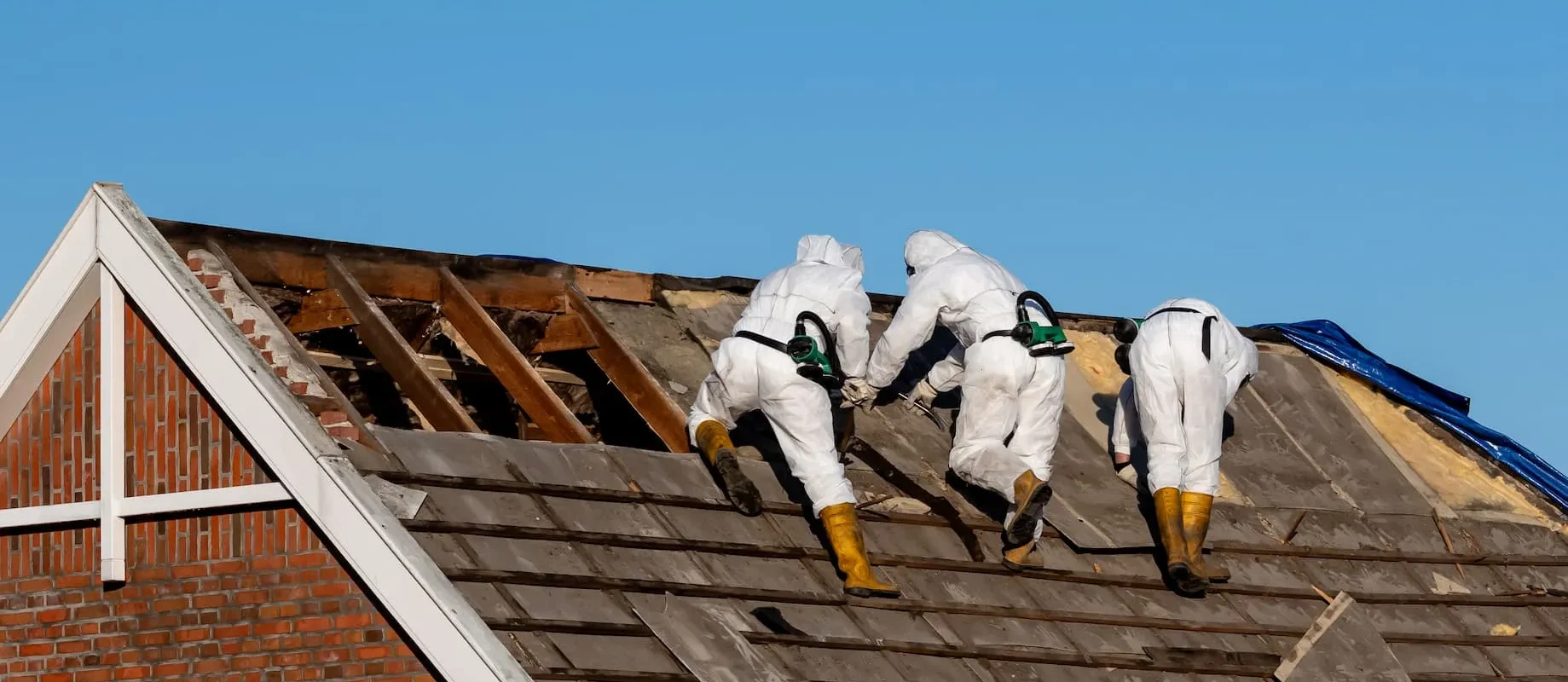
- Safe Removal: Our operatives enter the enclosure wearing full personal protective equipment (PPE), including disposable coveralls and advanced respirators. They use specialised techniques, such as controlled wetting of the ACMs with a fibre suppressant, to minimise the release of dust and fibres during the removal process.
- Bagging & Disposal: All asbestos waste is carefully placed into specialist, red, heavy-duty sacks. These are then securely sealed and placed inside a second, clear outer sack, which is also sealed and clearly labelled as containing asbestos waste. This waste is then transported in a secure vehicle to a licensed hazardous waste disposal facility, and all required legal paperwork (a waste consignment note) is completed to provide a full audit trail.
- Decontamination & Air Monitoring: Once all asbestos has been removed, the enclosure is meticulously cleaned using specialist HEPA-filter vacuums designed to capture the finest particles. A rigorous four-stage clearance process is then carried out by an independent, UKAS-accredited analyst. This includes a visual inspection, dust disturbance tests, and, crucially, a final clearance air test. Only when this air test confirms that the fibre levels are safely below the legal control limit is a Certificate of Reoccupation issued, and the enclosure can be dismantled.
VII. Why London and South London Choose Surrey Asbestos Surveys
Choosing an asbestos partner is a decision based on trust, competence, and reliability. At Surrey Asbestos Surveys, we have built our reputation on delivering exceptional service tailored to the specific needs of the London property market.
A. Unmatched Local Knowledge, Unbeatable Service
Our deep-rooted experience across London, and particularly in the southern boroughs, sets us apart. We have an intimate understanding of the region’s unique building stock—from the post-war council housing in Croydon and Bromley, with their common asbestos cement soffits and textured ceilings, to the Victorian conversions in Lambeth and Wandsworth, where asbestos insulation board was often used in 1960s and 70s modernisations. This local knowledge means we know what to look for and where to find it, leading to more efficient, accurate, and cost-effective surveys. Our local presence allows us to be fast and responsive, providing the reliable and affordable solutions our London clients demand.
B. Your One-Stop Solution for Asbestos Compliance
We offer a truly seamless, end-to-end service. From the initial friendly consultation and expert advice to the meticulous survey, impartial testing, compliant removal, and certified disposal, we manage the entire process for you. This integrated approach simplifies what can be a complex and stressful situation. It provides you with a single, accountable point of contact, ensuring clear communication and a smooth journey from identification to resolution. We take the burden of compliance off your shoulders, allowing you to focus on your property or project with complete peace of mind.
C. Our Pledge to You
Our company is built on a pledge to our clients: to deliver the highest standards of safety, professionalism, and transparency in everything we do. We are committed to protecting your health, safeguarding your property, and ensuring your absolute peace of mind.
If you have any concerns about asbestos in your London property, don’t wait and wonder. Take the first step towards a safe and compliant future.
Protect your property, ensure your compliance, and gain peace of mind. Contact Surrey Asbestos Surveys today for a no-obligation consultation about your asbestos survey and removal needs in London and South London.
VIII. Frequently Asked Questions about Asbestos Surveys in London
To help you further, we’ve compiled answers to some of the most common questions we receive from property owners in London.
How can I tell if my home has asbestos just by looking? You cannot. Asbestos fibres are microscopic and were mixed into thousands of different building materials. Materials like textured coatings (Artex), vinyl floor tiles, and cement boards can look identical whether they contain asbestos or not. Older buildings constructed before 1999 are more likely to contain asbestos. The only way to be 100% certain is to have a sample of the material professionally taken and analysed in a UKAS-accredited laboratory.
How much does an asbestos survey cost in London? The cost varies depending on the size and age of the property and, most importantly, the type of survey required (Management or Refurbishment/Demolition). A basic Management Survey for a small flat can start from a few hundred pounds, while a full, intrusive R&D Survey for a large commercial building will be significantly more. While cost is a factor, it’s crucial to prioritise value and competence. An inadequate cheap survey can cost you exponentially more in the long run through missed asbestos, project delays, and potential legal action. We provide transparent, competitive quotes tailored to your specific needs.
I’m buying a 1960s flat in South London. What should I do? It is highly advisable to have an asbestos survey carried out before you exchange contracts. An asbestos inspection is often requested by solicitors as part of the property transaction process to ensure compliance with health and safety regulations. If you are not planning immediate major works, a Management Survey will give you a clear picture of any asbestos present and allow you to plan for its future management. If you intend to renovate the property as soon as you move in, you should commission a Refurbishment Survey for the relevant areas. This will identify any asbestos that needs to be removed, allowing you to factor the cost and timeline into your renovation budget and potentially use the findings in your property negotiations.
My survey found asbestos. Do I have to remove it? Not necessarily. As explained above, if the asbestos-containing material is in good condition, is not likely to be damaged, and is not in an area scheduled for refurbishment, it can often be safely managed in place. This involves regular monitoring and ensuring anyone working in the property is aware of its location. Removal is only essential when the material is damaged or will be disturbed.
What does a surveyor actually do during the survey? The surveyor will conduct a methodical inspection of the property, both internally and externally. They will identify any materials they suspect may contain asbestos based on their appearance, application, and the age of the building, including suspected asbestos containing materials such as insulation, vinyl tiles, and textured ceilings. They will record the location, extent, and condition of these materials. Where required by the survey scope, they will carefully take small samples of the suspect materials for laboratory analysis. All this information is meticulously documented to form the basis of the survey report.
Is there a safe level of asbestos exposure? For mesothelioma, the scientific consensus is that there is no known safe threshold of exposure. Even very low levels of exposure can potentially trigger the disease years later. This is why preventing any release of fibres is the absolute priority in all asbestos management and removal work.
What are the most important things to look for in an asbestos survey report? Look for clarity and detail. Your report should have a clear executive summary, detailed notes on every sample and suspect material, marked-up plans or diagrams showing locations, and unambiguous recommendations for each item. It must also include the official certificate of analysis from the UKAS-accredited laboratory. A good report gives you a clear path forward.
What materials may contain asbestos? Asbestos can be found in a wide range of building materials, especially in older buildings. Common examples include insulation, cement boards, vinyl floor tiles, pipe lagging, and decorative coatings such as Artex and textured paints used on walls and ceilings. Always treat any suspect material with caution until it has been properly assessed.
IV. Preparing for Your Asbestos Survey: What London Property Owners Need to Know
Preparing for an asbestos survey is a vital step for any London property owner looking to ensure both safety and legal compliance. Before the survey takes place, it’s important to familiarise yourself with the different types of asbestos surveys available—namely, management surveys, refurbishment surveys, and demolition surveys. Each type serves a specific purpose, from ongoing asbestos management in occupied buildings to fully intrusive inspections required before major renovations or demolition.
Understanding your legal obligations under the Control of Asbestos Regulations 2012 is essential. These regulations set out clear requirements for identifying, recording, and managing asbestos in non-domestic premises, as well as in communal areas of residential buildings. Engaging a reputable asbestos consultancy can help you navigate these regulations and determine which survey is appropriate for your property type and planned works.
Before the survey, ensure that all areas of the property are accessible, and inform the surveyor of any planned building works or areas of concern. This preparation allows the asbestos surveyor to conduct a thorough inspection, collect samples where necessary, and provide you with a comprehensive report. By taking these steps, you not only ensure compliance with asbestos regulations but also lay the groundwork for effective ongoing asbestos management, safeguarding the health of all occupants and contractors.
V. Decoding Your Asbestos Survey Report: From Data to Decisions
Receiving your asbestos survey report is a crucial milestone, but understanding its contents is key to making informed decisions about your property. A high-quality asbestos survey report will clearly outline the location, type, and condition of any asbestos containing materials found during the inspection. It should also provide detailed sample analysis results, confirming the presence or absence of asbestos fibres in suspect materials.
Look for a report that includes a comprehensive asbestos register, which serves as a live document for ongoing asbestos management. The report should also offer clear recommendations for managing asbestos, whether that means ongoing monitoring, encapsulation, or safe removal. Understanding the different types of asbestos surveys—such as management surveys for routine occupancy, refurbishment surveys for planned upgrades, and demolition surveys for major structural changes—ensures that the report is tailored to your specific needs.
Working with a UKAS accredited asbestos consultancy guarantees that your report is both accurate and reliable. These experts will guide you through the next steps, helping you manage asbestos risks effectively and maintain compliance with all relevant regulations. By decoding your asbestos survey report and following its recommendations, you can confidently manage asbestos and protect the health of everyone who uses your property.
VI. The Hallmark of Excellence: Why UKAS Accreditation is Your Non-Negotiable Guarantee
When it comes to asbestos surveys and asbestos surveying, UKAS accreditation stands as the ultimate mark of quality and trust. The United Kingdom Accreditation Service (UKAS) is the government-appointed body responsible for assessing and accrediting organisations that provide inspection and testing services. Choosing a UKAS accredited asbestos consultancy means you are working with professionals who have demonstrated their competence, impartiality, and commitment to the highest industry standards.
A UKAS accredited consultancy undergoes rigorous audits and assessments to ensure that every asbestos survey is conducted with precision and integrity. This accreditation is your assurance that the surveyor’s findings are accurate, the recommendations are sound, and the process is fully compliant with all legal requirements. Managing asbestos and mitigating asbestos risks is a serious responsibility—one that demands the expertise and reliability that only a UKAS accredited provider can offer.
Never compromise on accreditation. By insisting on UKAS accredited asbestos surveys, you ensure compliance with regulations, safeguard the health of occupants, and protect yourself from potential legal and financial repercussions. Trust in the gold standard—choose a UKAS accredited consultancy for all your asbestos surveying needs.
VII. Air Testing and Monitoring: Ensuring a Safe Environment After the Survey
After an asbestos survey or any asbestos removal work, air testing and monitoring are essential steps to confirm that your property is safe for reoccupation. Asbestos fibres are invisible to the naked eye and can pose serious health risks if released into the air during removal or disturbance of asbestos containing materials. Air testing involves collecting samples from the environment and analysing them to detect any airborne asbestos fibres.
A professional asbestos consultancy will use specialised equipment to conduct air testing, ensuring that the area meets strict safety standards before anyone returns. This process not only verifies that asbestos removal has been carried out effectively but also provides peace of mind that the environment is asbestos safe. Regular air monitoring may also be recommended in properties where asbestos materials remain in place, as part of an ongoing asbestos management plan.
By investing in air testing and monitoring, property owners demonstrate a commitment to safeguarding health and ensuring compliance with all relevant regulations. Trust a reputable asbestos consultancy to carry out thorough air testing, collect accurate samples, and keep your property safe for everyone.
VIII. From Identification to Resolution: The Asbestos Removal and Management Pathway
Once asbestos containing materials have been identified in your property, it’s crucial to follow a structured pathway for asbestos removal and ongoing management. The right approach will depend on the type, condition, and location of the asbestos, as well as the property type and how it is used. A reputable asbestos consultancy will assess the asbestos risks and recommend the most appropriate course of action, which may include removal, encapsulation, or continued management.
Safe asbestos removal should always be carried out by licensed professionals who follow strict safety protocols and comply with all legal requirements. In some cases, encapsulation—sealing the asbestos material to prevent fibre release—may be a suitable alternative to removal. For properties where asbestos remains in place, a robust asbestos management plan is essential, including regular inspections and updates to the asbestos register.
By working with experienced asbestos consultants, property owners can ensure that every step—from identification to resolution—is handled safely, efficiently, and in full compliance with regulations. This comprehensive approach not only eliminates asbestos risks but also provides long-term peace of mind for everyone who lives or works in the property.